.svg)
.png)


Anchor Bolts for Pallet Racking:
The Small Component With a Big Job
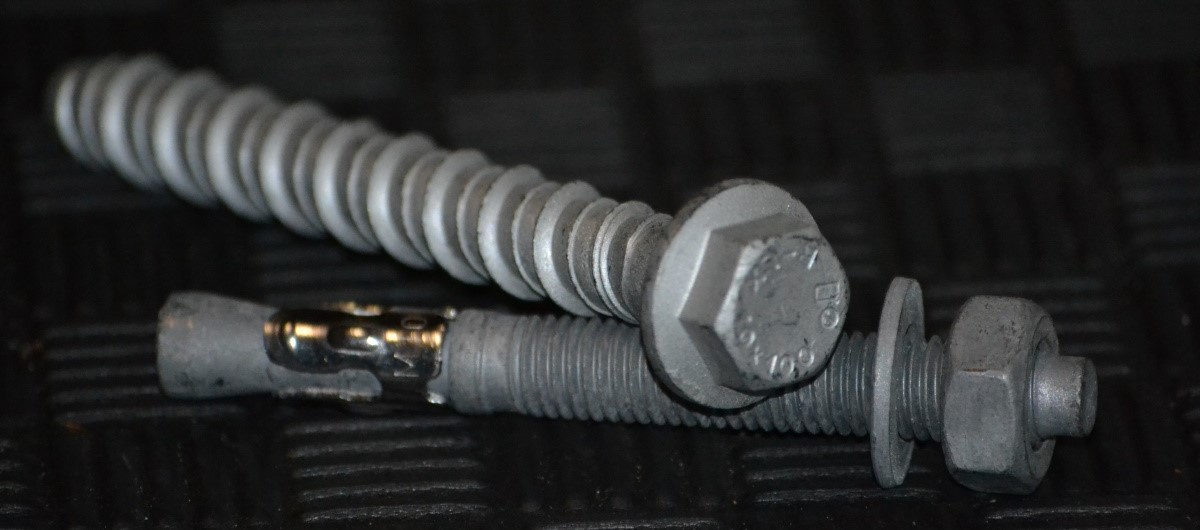
When people think about pallet racking safety, they tend to focus on the obvious stuff — damaged uprights, overloaded beams, missing safety pins. Anchor bolts rarely get much attention. They're small, they're at floor level, and once the racking is up, they're easy to forget about.
But anchor bolts are the final link between your racking system and the ground. Get them wrong, and the rest of the system — no matter how well designed or installed — is sitting on an unstable foundation.
In New Zealand, there's a specific set of rules around anchor bolts that go beyond what most warehouse operators realise. Let's break it down.
What Does AS 4084:2023 Say?
AS 4084:2023 is the standard we use in New Zealand for pallet racking design, operation, and maintenance. When it comes to anchor bolts, the key requirement is straightforward: a minimum of two anchors per footplate is required where racking is serviced by forklifts or other mechanical handling equipment.
This two-anchor minimum was already well-established industry practice before the 2023 update — it appeared consistently in manufacturer guidance and operational checklists referenced against the previous AS 4084:2012 standard. What changed in 2023 is that it's now explicitly stated in the standard itself, removing any ambiguity.
If your racking is only accessed manually — no forklifts, reach trucks, or order pickers — a single anchor per footplate may be permissible. In the vast majority of commercial warehouse environments, though, the two-anchor minimum applies.
The standard also requires that anchor bolts meet minimum strength criteria for the tension and shear loads the racking system generates. It's not enough to just put two bolts in — they need to be the right bolts, correctly specified for the installation.
The Floor Slab Is Part of the System
This is something that often gets overlooked: the concrete floor is a structural element, not just a surface the racking happens to sit on.
AS 4084:2023 requires that the floor be assessed as suitable before anchoring. A floor that's cracked, delaminated, or below the required compressive strength can't reliably transfer the loads from your racking — regardless of what bolt you use. If an anchor is installed into compromised concrete, it won't achieve its rated capacity.
New Zealand's concrete floor and pavement design guidance (CCANZ TM38) specifically notes that racking bolted to floor slabs can develop uplift forces during seismic events, and the slab must be designed to accommodate these forces. Some racking manufacturers design their systems with yielding base plates to limit peak uplift loads on the slab — another reason why the racking supplier and floor designer need to be talking to each other during installation.
The New Zealand Difference: Seismic Requirements
Here's where New Zealand's requirements diverge from what you might see in Australian guidance.
Following Amendment 3 to NZS 3101:2006 (the Concrete Structures Standard), published in 2017, post-installed anchors used in seismic applications must meet European prequalification testing standards — specifically EOTA TR 049 for testing and Eurocode 2 Part 4 for design.
In plain terms: standard mechanical expansion anchors may not be sufficient for racking installations in New Zealand if they haven't been prequalified to these seismic standards. Seismically rated anchor systems from manufacturers such as Hilti, Fischer, and similar suppliers carry this prequalification and are the appropriate product for compliant installations.
This requirement applies nationwide — not just in Wellington or Christchurch. That said, the seismic demands on anchor specifications do vary by location. High seismic zones (Wellington, Christchurch, Hawke's Bay, Marlborough) typically require more heavily rated anchors and may result in racking loads being derated compared to lower seismic zones like Auckland and Hamilton.
WorkSafe NZ guidance is also clear that under the Health and Safety at Work Act 2015, racking must be fixed to the floor as part of a PCBU's duty to manage risks in the workplace.
What Inspectors Are Looking For
During a racking audit to AS 4084.2:2023, anchor bolts are inspected as part of the footplate and floor fixing check. Key items include:
- Are both anchors present? Missing anchors are a common finding — sometimes skipped during original installation, sometimes removed and never replaced.
- Are they tight? Loose bolts can indicate concrete degradation beneath the footplate, insufficient original torque, or loosening from ongoing MHE traffic. Anchors should be retightened to the manufacturer's torque specification, not just snugged by hand.
- Are they damaged? Corroded, sheared, or bent anchors need to be replaced — not just retightened.
- Is the footplate in good condition? A bent or deformed footplate is often a sign of impact loading and may indicate the anchor's embedment has been compromised.
- What's the concrete like around the fixing? Spalling or cracking at the anchor location is a red flag that warrants further investigation before the installation is considered sound.
Common Findings in the Field
In practice, anchor-related issues come up regularly during audits. The most common non-conformances we see include:
- Footplates with only one anchor installed despite the two-anchor requirement
- Standard (non-seismically rated) anchors where NZS 3101:2006 Amendment 3 compliance is required
- Anchors installed without reference to the designer's documented specification
- Loose or corroded anchors not caught by internal inspection processes
- Cracks in the concrete slab around the baseplate and anchors
Each of these is a compliance gap under both AS 4084:2023 and New Zealand's health and safety legislation.
Ready to check your anchors & slab?
If you're not sure whether your racking's anchor bolts are up to standard — or if your last inspection didn't include a thorough check at floor level — get in touch with Rack Safe Industries.
We carry out independent racking audits across the Auckland region and beyond, with compliance reports referenced to AS 4084:2023 and relevant New Zealand standards.